What Is the Definition of Asymmetrical Balance in Art

How does good visual balance affect the fashion we run into and perceive things? When a visual blueprint isn't balanced, nosotros often feel like something's "off" but tin can't put it into words.
Achieving visual balance is all about how things—objects, colors, subjects— relate to each other in the composition equally a whole. Symmetry and asymmetry are ii of the main tools at your disposal for creating a balanced graphic blueprint that will delight instead of put off.
In this guide, we'll expect at examples of asymmetrical balance and tips on how to reach it. Plus, y'all'll notice a drove of Visme templates using asymmetrical balance that you can customize correct abroad.
But why are we talking about disproportion when symmetry is seemingly more perfect and grounded?
Well, because symmetry can get boring. Asymmetrical balance feels organic, fluid and alive.
Do you want to larn more than near design principles to help you design, even if you lot don't accept design skills? Check out the video below:
What is Asymmetrical Balance?
In design—and in art—there are visual rules that help the creative person or designer create visually appealing or even beautiful compositions. Limerick is a vital design skill that plays a part in every project, regardless of the scope. When a pattern has a well-achieved limerick, the viewer feels a subconscious connexion through emotion and association .
One of these rules of composition is called visual balance, and information technology's possibly one of the most important. And then significant that if a design—photograph, piece of art or compages—doesn't take a practiced visual balance, everything else goes out the window.
Ane of ii essential tools to achieve visual balance is disproportion, specifically asymmetrical residual; the other is symmetry. Think of a seesaw; on the top left is a skinny giraffe wearing a scarf blowing to the left behind information technology, and on the lesser right is a thick hippopotamus with its rump on the ground.
The centre mechanism of the seesaw is a betoken of balance for the asymmetry; the long neck of the giraffe and its scarf residuum out with the inundation rump of the hippopotamus. When elements in the sheet are non symmetrical simply instead balance each other out through colour, shape, size and texture, this is asymmetrical balance.
Symmetrical Residual vs. Asymmetrical Remainder
Allow's do a little exercise.
Get a pen and paper and draw three shapes; a circle, a square, and a blob. Now draw a line that runs through the center from top to bottom on the three shapes. Now, if you were to fold the shapes forth the line, the circumvolve and the square would fit perfectly on themselves, only the blob would non. This line is the line of symmetry, the circle and square are symmetrical shapes, and the hulk is asymmetrical.
Symmetry and asymmetry are technical opposites. The concept of symmetry is a characteristic in which an object is the aforementioned on both sides, folding over on the line of symmetry, only how you saw in the exercise above.
At that place are iii chief types of symmetry;
- Reflexive: The human body—and many other animals—accept reflexive symmetry. A line of symmetry runs vertically through the centre, and each side reflects the other.
- Rotational: Nosotros see rotational symmetry in natural objects like starfish and flowers and manufactured things like wheels and mandalas.
- Translational: This blazon of symmetry is a bit different. It'south near how an object repeats and is laid out from the original object.

Symmetry in design and art is more axiomatic than disproportion. When you come across symmetrical things, they feel stable, grounded, complete. For example, movie managing director Wes Anderson is famous for using symmetrical compositions in his movie scenes. He achieves such deep and delicious symmetries that they've caught the attention of movie buffs and mathematicians alike.
The main departure between symmetrical and asymmetrical balance is how it'south perceived. Symmetry is more structured than disproportion in the sense that there's a rule to be followed. There must be at least ane line of symmetry for achieving symmetry, a identify where the objects reflect, rotate, or translate. That'south why symmetrical balance is more challenging to attain than asymmetrical balance.
Asymmetry is more than nearly the overall feeling of the artwork or pattern. The visual residuum in asymmetry has a looser sensation, less structured than perfect symmetry. It also helps in achieving a clear visual hierarchy .
Just is symmetry ever perfect?
In nature, symmetry is present in animals and plants alike, simply information technology's never 100% perfect. If you were to take a photo of only one one-half of your face and then reflect information technology side past side, it wouldn't await like you anymore. That'south because even though our faces expect symmetrical, they are unique on each side. The same happens with flowers, leaves, mushrooms; you name it.
Even if an asymmetrical balance doesn't feel structured, grounded and perfect, it's more natural than symmetrical balance. It feels more than existent.
Examples of Asymmetrical Balance
To ameliorate understand asymmetrical residue, yous have to see information technology in activity. Here's a selection of asymmetrical balance in use on different visual niches.
Take annotation of how these make you feel; do they impart a sensation of balance and stability?
Art
The Hokusai wave is a Japanese wood print that uses asymmetrical balance to tell a story of motility, action and intensity. Balance is achieved with the size and bend of the wave and the boats full of people diagonally underneath it. Besides, a section of another wave on the far right balances out the movement happening on the left. The peak of Mt. Fuji in the background adds a impact of depth, further balancing the scene.
Graphic Blueprint
Magazine layouts are the perfect example of asymmetrical balance in graphic pattern. Two-page spreads designed with asymmetry make the content fun to read and enjoy. In the example beneath, there's a diagonal sensation to the pages.
The header in the centre leans towards the left and balances with the greyness rectangle on the right. Too, the decorated top left corner balances with the empty bottom correct corner.
Illustration
In illustration, asymmetrical balance is doable when laying out compositions of the elements. Decorated sections remainder out with empty areas, gradients balance each other with backgrounds and textures.
The illustration example below uses angles, diagonals and color to create asymmetrical balance in the scenes. White and black areas don't compete with the pink jacket; instead, the asymmetry makes information technology stand out.
Packaging Design
Asymmetrical residual in packaging design makes products memorable. Using disproportion in packaging design will make the overall design stand out, specially using contrasting colors that make an impact. The packaging design for the cans in the example beneath is an fantabulous example of asymmetrical balance using color and shapes.
The waves residual out with the direct lines and geometric font while also going around the can in an disproportionate design. At every angle, the design effectually the can is balanced and attractive.
Photography
Achieving asymmetrical balance in photography is a skill that needs practicing. Setting upward a static scene that is balanced asymmetrically is easier than capturing objects in movement. Take a look at the photo below; the juxtaposition of the jumping and standing children creates a beautiful asymmetrical balance.
We'll never know if the lensman took this photo knowing that this balance would happen, but you can exist certain that they chose this one to impress considering of this visual upshot.
Web Design
Website pattern and asymmetrical balance go hand in mitt in many ways. Even if the blueprint in a higher place the fold is symmetrical, you lot can be sure that asymmetry starts to show equally y'all curl. This is considering too much symmetry, peculiarly perfect symmetry, gets boring speedily.
In the instance beneath are many aspects of visual rest. The direct lines and blackness color on the left balance the bend and color on the correct.
Architecture
Architects also use asymmetrical residual to design unique buildings that don't fit the mold and stand up out. Creating asymmetrical residual with construction is trickier than with design because it involves a lot of engineering, so the asymmetrical blueprint doesn't interfere with the construction.
The building in the image below is the Walt Disney Concert Hall, designed by builder Frank Gehry is an excellent example of asymmetric architecture.
v Ways to Utilize Asymmetrical Balance in Your Visual Content
Are you feeling a bit asymmetric today?
Like, maybe yous desire to try out this technique in your visual projects?
Skilful news, hither are some tips to assist you achieve asymmetrical remainder in your designs. We'll use some of our Visme templates that use asymmetrical balance as examples. All these templates are available for you to use at any fourth dimension inside your Visme dashboard.
Let'southward get started.
1. Z Layout Flow
The Z layout flow is the easiest manner to achieve asymmetrical remainder. The content starts on the left and and so zigzags. Technically, a Z layout flow could be symmetric or asymmetric; it depends on the supporting elements and overall shapes. Here are some examples.
Infographics
This infographic has a Z layout flow with asymmetric residue. Each data signal has a unique shape, and the icons and numbers are asymmetric. Even though in that location is no apparent symmetry, in that location's an overall feeling of remainder; this is the visual residue you always want to accomplish with disproportionate pattern.

In this infographic, the asymmetric balance is more axiomatic than above. The zigzag line with specific information points goes from left to correct and is easy to edit without disrupting the overall balance. This blueprint is easy to continue if you accept more content to add.

2. Color and Size
The following technique to create asymmetrical residual is color and size. Using contrasting colors and different sized elements helps the visual balance of your designs with an asymmetric feel. Here are a couple of Visme templates using this visual technique.
Documents
The Monthly Customer Service template uses colorful shapes that mix with the content and line the left side of the pages. The contrasting colors in soft pink, intense green and bright orangish residual each other out in dissimilar ways on every folio. Visual balance on this certificate template is well achieved using asymmetry on every page.

Likewise, this proposal template also uses color and size to attain asymmetrical balance. In this case, it'due south a chip dissimilar. The cover has an asymmetrical residual, with the red roof on the bottom third of the page and a vivid blueish heaven above. The pages within the proposal also have asymmetrical residuum, contrasting the aforementioned photo with white areas.

3. Rule of Thirds
The dominion of thirds is a design technique that separates the canvas into nine equal parts by adding two vertical and two horizontal lines. Visualizing the shapes on the canvas makes it easier to identify elements to achieve asymmetrical balance. Here are some templates that use this technique.
Digital Magazine
The Fitness Magazine template uses asymmetrical balance from cover to cover, but this page is the best example of using the Rule of Thirds to accomplish asymmetrical balance. As you tin see, the content has varying weights on each section. If you wish to use this template and keep the visual residuum, endeavor and keep the textual content the same size.

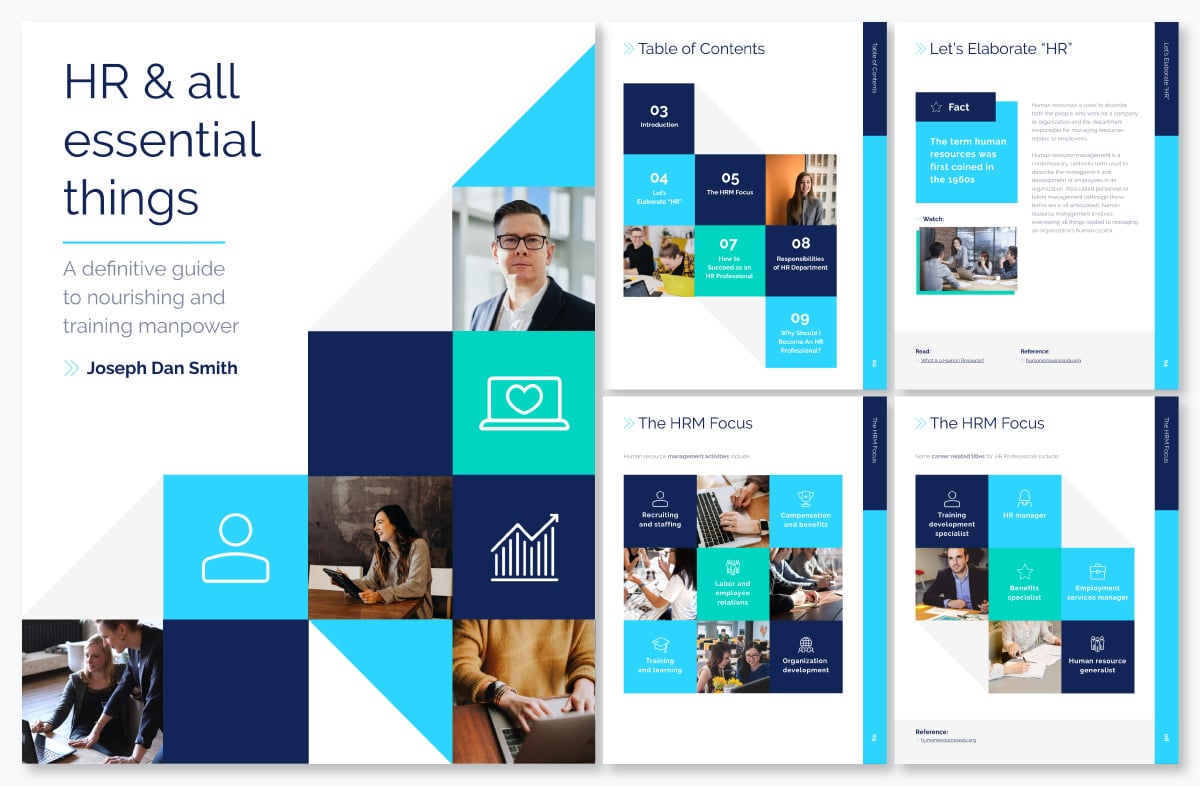
Ebook Cover
This ebook cover uses geometric shapes laid out on the cross-sections of the rule of thirds on the lesser correct while leaving the height left clear and with lighter color shapes. This diagonal pattern is easier to achieve with the rule of thirds because it helps align the content and balance information technology.
4. Complexity and Simplicity
Complication and simplicity is a visual technique that contrasts to balance asymmetry, using textures and details in different capacities. The thought is that one expanse of the design is complex while the opposite side is simple. Here is a template to assistance you lot visualize complexity and simplicity.
Digital Catalog
Take a look at this cover for a furniture catalog. The complication is at the lesser with the furniture and colorful decorations. Above it, the championship of the itemize has a much simpler background of wall and calorie-free shining upon it. Notice how the chief color is mustard yellow, creating a unifying sense to the overall design.

5. Perspective
Perspective is the last visual technique to help y'all accomplish asymmetrical residuum. Photography is the most straightforward visual to use every bit a foundation for asymmetrical residue, especially images that use perspective equally the focal point.
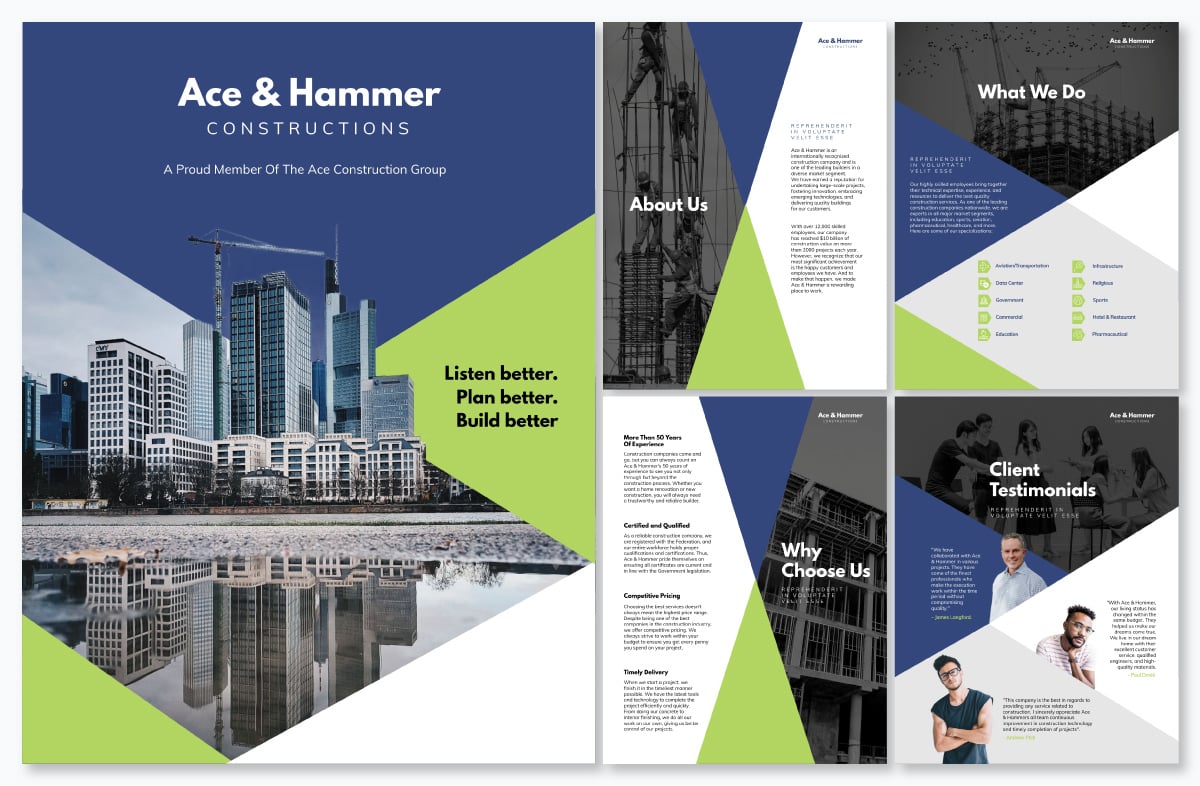
Booklet
A photograph is at the eye and off to the left in this template, creating a visual perspective. The blueish and green diagonal shapes reinforce the idea of perspective and asymmetrical residuum. Diagonal lines and shapes are the all-time tools for a perspective emphasis on residue.
Add together Asymmetrical Rest to Your Visme Projects
Using asymmetrical remainder is an excellent way to turn a regular design into an exceptional one. With Visme, it'southward piece of cake to create asymmetric designs using templates, content blocks and the slide library. All you need to do is follow our pattern suggestions for achieving asymmetrical balance:
- Z Layout Menstruation
- Color and Size
- Rule of Thirds
- Complexity and Simplicity
- Perspective
If you're not sure your asymmetric design is balanced visually, click on the present push button to view it over a nighttime background. Step back from your screen a picayune and let yourself experience an emotional reaction. Does it feel counterbalanced in its disproportion? That means you've achieved asymmetrical residuum.
If you don't yet have a Visme account, create one easily with your email or Facebook business relationship. You'll be creating designs with asymmetrical remainder in no time!
Source: https://visme.co/blog/asymmetrical-balance/
0 Response to "What Is the Definition of Asymmetrical Balance in Art"
Post a Comment