Online charter school students learning less than peers, study finds
Credit: Laurie Udesky/ EdSource Today
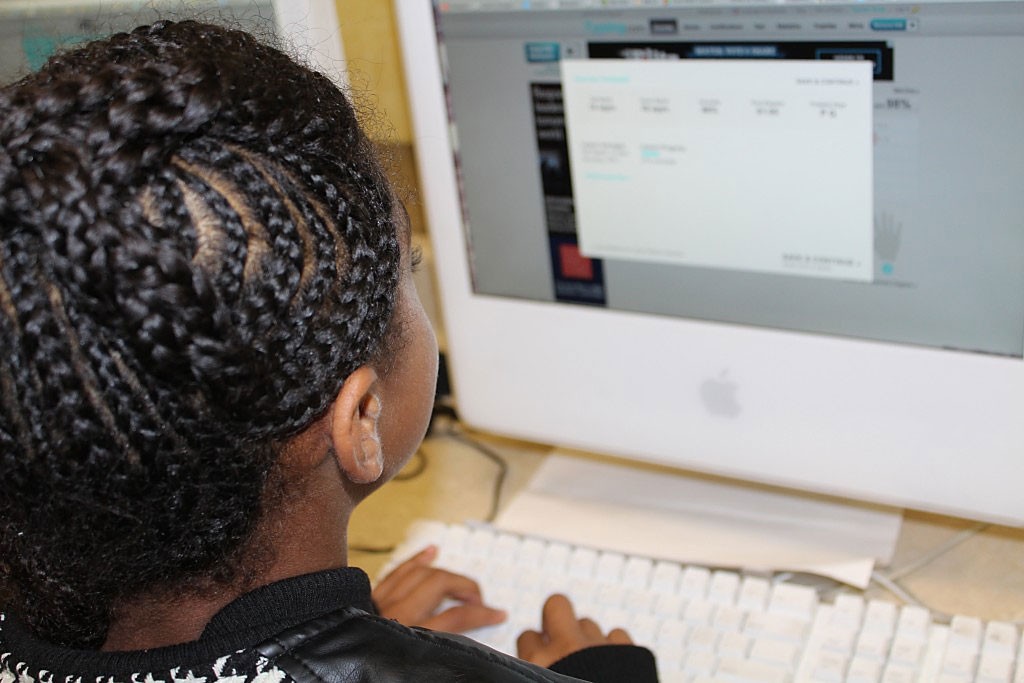 Credit: Laurie Udesky/ EdSource Today
The bulk of students who attend online charter schools in California and beyond the nation are falling significantly behind in math and reading compared to their counterparts in conventional schools, according to the first national, comprehensive study of online charter schools, released Tuesday.
On average in California, academic growth for students was "extremely" negatively affected by attending an online charter schoolhouse, with the upshot in the land more negative than in the national average, according to James Woodworth, lead analyst for the Center for Research on Educational activity Outcomes at Stanford University. The center is one of three research institutes that produced separate reports that were released collectively every bit the National Written report of Online Lease Schools. The other institutes were the Centre on Reinventing Public Education at the University of Washington and Mathematica Policy Inquiry.
The study compared online charter school students, who receive instruction through computers at domicile, with like students in traditional schools who had the same economic groundwork, prior test scores, special education condition, history of beingness held back a grade, English language Learner status and other variables.
"Information technology's not that online charter schools necessarily tin't work, simply under the electric current structure and the manner they're operating, they are not working for almost kids," said James Woodworth of Stanford's Center for Research on Instruction Outcomes.
The findings of the report, which collected data almost full-time, online charter school students in the Commune of Columbia and 17 states, including California, were not all negative. Nationally, about 30 to 40 per centum of students in online charter schools performed the same equally, or better than, their peers in traditional schools, Woodworth said.
"Information technology'southward not that online charter schools necessarily tin can't work, simply under the current structure and the way they're operating, they are not working for most kids," Woodworth said.
K12 Inc., in a response to the study, disputed the validity of the poor academic results documented. Given that online lease schools are often "schools of concluding resort" that attract students who have struggled in traditional schools, the K12 Inc. statement said, the study could not accurately compare performances between groups of students.
"I sympathise K12'south position, it's a little close to domicile for them," Woodworth said, "simply at aforementioned fourth dimension we have looked at this really hard using most recent data." He said, "We experience it'south a actually solid comparison and nosotros stand up behind that."
Researchers tested the data in multiple ways, he said — by tracking longitudinally an individual educatee'southward academic growth or decline from 2007-08 through 2012-13, by tracking the academic functioning of students who entered online lease schools and then later returned to traditional schools and students who did the opposite, and by comparison online charter schoolhouse students with peers who attend traditional lease schools. "Every assay we ran comes out in the aforementioned direction and the same magnitude," Woodworth said.
Online charter schools, also known equally virtual charter schools, enroll a minor percentage of students in California, but the model has been idea to hold promise in reaching students who for a diverseness of reasons, including existence bullied at school, suffering from social anxiety, or being on the verge of expulsion, opt to learn at home. The schools are publicly funded and authorized past local schoolhouse districts. In California, the largest providers are K12 Inc., which operates California Virtual Academies, and Connections Education, which operates California Connections University.
But the study suggested that the model has a long manner to go. Forth with an achievement consequence, the study said the schools struggled to keep students engaged, a problem inherent in a situation where students are learning at habitation, frequently on their ain schedule. That challenge is made worse by high student-instructor ratios and minimal student-teacher contact time, which the study institute to be typical of online charter schools nationwide, said Brian Gill, a Mathematica senior fellow, in a argument.
"These findings advise reason for business most whether the sector is likely to be effective in promoting educatee achievement," Gill said.
The National Written report of Online Charter Schools was funded past the Walton Family unit Foundation. "We support research on difficult questions similar these because we want to know what is working for kids — and what is non," Marc Holley, director of research and evaluation for the foundation, said in a argument. "Innovation in education takes fourth dimension, just we must test whether new ideas are working and make changes when nosotros larn that ideas with potential are falling short," he said.
To go more reports similar this one, click here to sign upwardly for EdSource'south no-cost daily email on latest developments in education.
Source: https://edsource.org/2015/online-charter-school-students-learning-less-than-peers-study-finds/89662
0 Response to "Online charter school students learning less than peers, study finds"
Post a Comment